Opening Doors to Creativity for a Special Needs Child

by Muriel Alexander

Parents of special needs children often wonder how to introduce creative outlets in ways that feel welcoming rather than overwhelming. The arts can become a steady companion here, offering sensory regulation, communication pathways, and moments of joy that don’t rely on words. When approached with patience and flexibility, creative activities meet children where they are and grow alongside them.

Why Creative Expression Matters So Much

For many children with special needs, traditional forms of learning can feel rigid or tiring. Art, music, movement, and drama offer a different entry point—one rooted in play and exploration. These activities can support emotional regulation, fine and gross motor development, and self-expression, especially when verbal communication is limited. Over time, the arts become less about producing something “right” and more about experiencing freedom and agency.
Starting Where Your Child Feels Safe

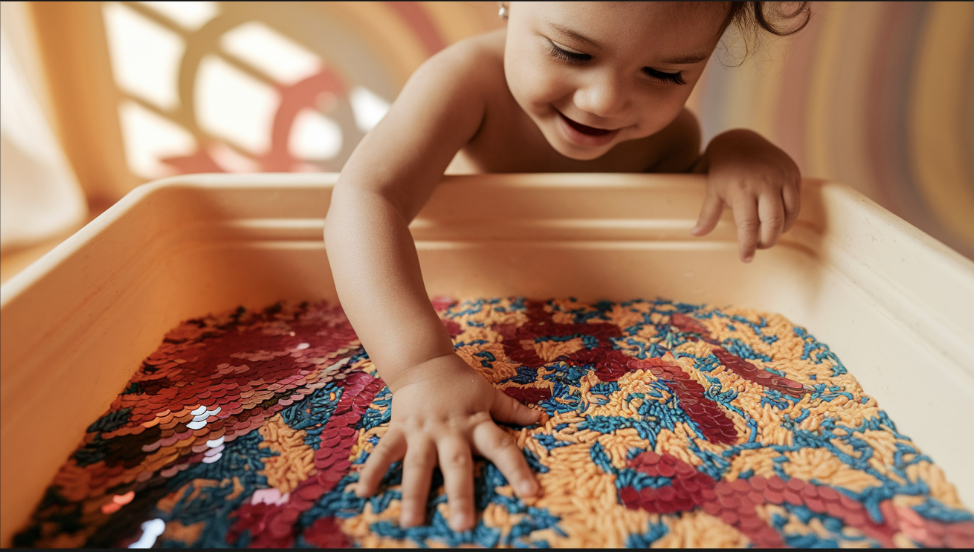
The most successful creative experiences begin with observation. Notice what textures, sounds, or movements your child already enjoys, and let those preferences guide you. A child who loves water might enjoy watercolor painting or sensory play with ice, while a child drawn to rhythm may respond to drumming or clapping games. By following existing interests, you reduce resistance and build trust.

Inviting Creativity at Home

Before diving in, it helps to remember that creativity isn’t about talent, training, or costly supplies—it grows out of small, intentional choices that make creative moments feel safe and inviting:

  • Keep materials visible and accessible so creativity feels spontaneous.
  • Offer choices rather than instructions to encourage autonomy.
  • Allow repetition; familiarity often builds confidence.
  • Celebrate effort and engagement instead of outcomes.

Adapting Activities to Different Needs

Every child processes sensory input differently, so flexibility is essential. Some may need quieter spaces, softer lighting, or noise-canceling headphones to stay engaged. Others thrive with movement breaks or activities that involve the whole body. Adjusting tools—like using thicker paintbrushes, adaptive scissors, or digital drawing apps—can remove barriers without diminishing the experience.
A Gentle Planning Framework for Parents

When planning creative time, grounding yourself in a simple rhythm can help keep sessions enjoyable rather than stressful.

  • Choose one activity and keep the session short at first.
  • Set up the space in advance to reduce transitions.
  • Stay nearby, but let your child lead the pace.
  • End on a positive note, even if engagement was brief.
  • Reflect afterward on what felt calming or exciting.

Arts Activities and the Benefits They Can Offer
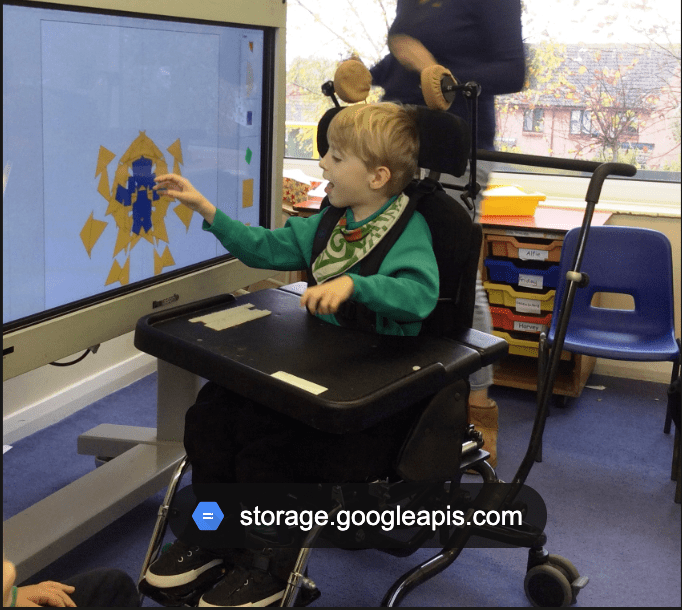
Different forms of art support different developmental areas, and variety allows children to discover what resonates most.

Art FormPossible BenefitsHow to Adapt
Drawing and paintingFine motor skills, emotional expressionUse finger paints or adaptive grips
Music and rhythmSensory regulation, communicationStart with simple beats or familiar songs
Dance and movementBody awareness, confidenceFollow the child’s movements without correction
Drama and pretend playSocial understanding, imaginationUse puppets or simple role-play scenarios

When Creativity Sparks Something More for Parents

As you spend time creating alongside your child, you may notice something unexpected: your own interest in making things starts to grow. For some parents, the arts become more than a shared activity and begin to feel like a genuine personal outlet. Over time, that interest can turn into curiosity about whether creative work could fit into a larger part of life. Some parents explore paths like teaching, animation, crafting, or designing and selling handmade pieces, including jewelry. There are many ways to build a sustainable future around your interest in art without rushing the process.
FAQs for Parents

Before investing in classes, supplies, or structured programs, many parents want practical answers to the same core questions.

How much time should my child spend on creative activities each week?
There is no universal amount that works for every child. Short, regular sessions often have more impact than longer, infrequent ones. Let your child’s energy and interest guide the schedule.

What if my child refuses to participate?
Refusal is often communication rather than defiance. Step back, adjust the activity, or simply observe alongside them. Engagement may come later once pressure is removed.

Do I need professional instruction to get started?
Professional guidance can help, but it isn’t required. Many families begin successfully with simple, home-based activities. Occupational or art therapists can offer ideas if challenges arise.

Can the arts support social skills?
Yes, especially when activities are shared. Group music, collaborative art, or gentle role-play can encourage turn-taking and shared attention. Progress is often subtle but meaningful.

Are digital tools appropriate for creative expression?
For some children, digital platforms reduce sensory overload and increase control. Drawing apps or music software can be excellent alternatives to traditional materials. Balance screen-based creativity with physical experiences when possible.

Closing Thoughts

Helping a special needs child engage with the arts is less about instruction and more about companionship. Creativity unfolds slowly, often in quiet moments that don’t look like progress at first glance. By staying curious, patient, and open, parents can create spaces where expression feels safe and valued. Over time, those spaces can become sources of growth for the entire family.

Do kids need a Dad? Ask single moms

https://www.npr.org/2025/12/08/nx-s1-5634899/do-kids-need-a-dad-ask-single-moms

More women than ever are choosing to raise their children by their self. Is it time to hit reset on what we mean by “family” in America?

America has some deeply held prejudices toward single moms, but some studies show that 40% of babies in the U.S. are born to unmarried women. In this episode Brittany looks into the joy and challenges these women face – from freedom and agency to affordability and loneliness.

Brittany is joined by Pallavi Gogoi, NPR’s Chief Business Editor, and Danielle Elliot, writer and a single mother. You can read Pallavi’s reporting here.

Stay-at-Home Mom’s Guide to divorce.

Divorce is a tough journey for everyone, but it can be particularly vexing for stay-at-home moms. Often, stay-at-home parents have given up their careers to care for their children and allow their spouses to continue on a career path. Now, they face the challenge of rebuilding their lives and providing for themselves and their children.  But there is help and guidance for all moms.

Click on the link for lots of information, legal and financial advice to get you through it. There is light at the end of the tunnel.

Stay-at-Home Mom’s Guide to Divorce – omaralawgroup.com/stay-at-home-moms-guide-to-divorce/

Talking To Your Children About Death

Q&A with Clinical Assistant Professor, NYU School of Medicine Chrissy Salley Ph.D

In Loving Memory of Salvino Luis Ceballos – July 8, 2015 – June 3, 2023

Luke and Salvino were not great friends.  They played together on occasion, they also fought on occasion, and they certainly had many laughs together.  Whenever they would get into any arguments, me and Salvino’s Dad, Camilo, would just throw our hands in the air and say “let them work it out, they’ll be fine”, and they were.  As they got older and more mature, Salvino and Luke got along better, and they would greet each other warmly on the streets whenever they saw each other.

On a bright and warm Sunday morning of June 4, I got a call from a friend telling me Salvino died suddenly.  He was seven years old.  A bit of my breath was taken away.  I could not believe what I was hearing.  The day turned into parents coming together trying to comfort each other, with lots of tears and figuring out what we could do to support Camillo and Anastasia, Salvino’s parents.  The whole community came together in such a way I had never seen before.  Go Fund Me was started, Meal Trains began, and flowers and candles were dropped off at Camillo and Anastasia’s wine shop in the neighborhood that everyone loves so much.


A memorial the following week was planned by many of the parents and family at the park that Salvino played at so often.  It was truly a beautiful memorial.  Everyone contributed something, even those that did not know the family or Salvino very well.  Salvino’s Principal came and gave a heartfelt eulogy, Salvino’s drum teacher did a performance, friends and family told sweet and funny stories about Salvino’s life.  There were kid stations set up where people could paint Salvino’s name on rocks and tote-bags.  Children wrote notes and drew pictures in Salvino’s Memorial Book.  There was music and face painting and ice-cream.  It was a wonderful way to honor Salvino’s beautiful life. 

Discussions kept coming up from parents about how do we talk to our kids about death, and the death of a child no less?  Some parents decided not to tell their kids, some decided too.  I made the decision to tell Luke.  His response was a bit dismissive, and I just figured, this concept is too complicated for him to understand.  Death is complicated even for adults to understand, how can a 6-year old understand it?   About a week later, Luke said to me “Mommy, I’m going to write God a letter to make sure he is taking care of Salvino”.  As I wiped a tear away, I realized he must have gotten the concept of death more than I had realized. 

It certainly got me wondering on what parents should do in a distressing situation like this.  I turned to Grief Counselor Dr. Christina Salley for some expert advice, and I hope it will shed some light.  But no matter what a parent decides to do when there’s a death amongst friends or family, the best thing you can do is give your child a big, long hug.

Q. Is there an age or age range when children fully understand the concept of death?

During the preschool years, children begin to understand the concept of death and parents can begin telling their children about a loved one’s death at this time than younger ages. It is normal, however, for preschoolers to believe the individual will come back and to not fully grasp the finality of death.

By the time children reach elementary school they begin to understand the finality of death. Younger elementary aged children may still fantasize about the return of the deceased, but caregivers can re-iterate that the person is no longer alive and will not come back.

Q. What age should a child be allowed to go to a religious service such as a funeral/wake/Shiva, etc? 

A. Toddlers or preschoolers require a lot of care and will not have the language skills to understand what is happening at a service. Therefore, it will require the caregiver to consider several factors before taking a very young child to a service. A service which is happening at an unfamiliar place (e.g., a church) where there is a lot of expressed emotion may confuse a young child. Other gatherings, such as families convening within a known home may feel relatively “normal” to the child. Caregivers should consider the environment, their ability to tend to their child’s reaction, and whether there is an available plan to remove the child if needed when making this decision.

Children who have entered elementary school should be offered the opportunity to talk with their caregivers about whether or not they will attend a service. Caregivers should explain, in plain terms, to the child exactly what to expect should they attend. Details including where the services will be, who will be there, what they can expect to see (including emotional reactions and the deceased person’s body) should be included. They should also know if there will be a separate room that they can stay in with toys or an electronic device for a part of or the entire duration of a service. Caregivers should refrain from assuming that the child (should not) attend the service as the child may not want to be alone in their grief. Understanding the child’s needs and preferences will inform the best decision.

Q. If they shouldn’t go or don’t go to a service for whatever reason, what is the best way for them to have closure?

A. There are many creative ways for a child to say “good-bye” without attending a service. These options may be more developmentally appropriate, comfortable, and satisfying for some than attending a service. The child can write a letter, draw a picture, say a prayer, plant a flower, donate money to a cause, or engage in any other meaningful activity. The activity itself does not matter so long it helps the child feel connected and gain closure.

Q.  How should we talk to children about death, are there certain words we should avoid or use when talking about death?

A. Talk to children about death in plain terms. Use the words “died, death, dead” and explain this means the person’s body stopped working. Words like “passed away, not with us, sleeping forever” are vague and will leave the child questioning. Encourage the child to ask questions and explain that any way they feel is okay.

It is normal for adults to struggle with having these conversations. Books are an excellent way to help children learn and talk about death.  For a list of books related to bereavement check here: https://courageousparentsnetwork.org/guides/bereavement-bibliography-2.

Q. Can you explain the grieving process of a child?  Is it different if another child dies versus an adult who dies?

A. The grieving process of children often looks differently from that of adults. Sadness can be expressed as anger, behavioral outburst, or sudden mood changes, any of which may seem triggered by things unrelated to the death. Infants and very young children may be extra clingy and moody. There may be sleep disturbance, nightmares, accidents, or other behavioral regressions. They may worry that they may die or that another loved one may die. They may express physical symptoms such as stomach aches.

On the other hand, adults are often confused when children do not seem to express any sadness. They might feel like the child “doesn’t get it” or is not processing grief in a healthy way if they are moving forward and playing and laughing normally. This is okay and normal. Children process grief in their own way.

Q. Should we talk to kids differently if an adult dies vs another child?  

A. Oftentimes caregivers worry that telling their child that another child has died will cause them to worry about their own death. Similarly, they are concerned that explaining an adult has died may cause them to worry another beloved adult will die. Children should be invited describe their thoughts and worries. This will allow the caregiver to understand exactly what the child is concerned about so that their response can match the worry.

Children should know if/how their day-to-day may be affected by the death. For example, if there is a death of a soccer coach they can be reassured that the soccer season will continue and that another person will be coaching the team.

Q. What are the signs that a child may have some post trauma from the death of a loved one?

A. If emotional or behavioral changes related to death are interrupting a child’s functioning, such as attending school, doing normal social activities, or joining in typical family routines they may be having an especially difficult time coping. Other concerning signs may be expressing guilt about the death, experiencing intense and recurrent thoughts about death, or feelings like they no longer want to live.  In these cases, seeking help from a professional can be beneficial.

**I recommend linking to these sources**

For additional information, check out:

Helping Children Cope with Grief

https://courageousparentsnetwork.org/guides/bereavement-websites-and-camps https://courageousparentsnetwork.org/guides/parenting-after-child-loss

https://www.dougy.org

Chrissy Salley, Ph.D. 
Hassenfeld Children’s Hospital at NYU Langone
Department of Child and Adolescent Psychiatry
Child Study Center
christina.salley@nyulangone.org
nyulangone.org
facebook.com/nyuchildstudycenter

Raising A Child Can Costs Over $30K Per Year

by Patrick Villanova

The ongoing costs of child-rearing can be hard to size up – and digest. The average cost to raise a child in the U.S. is $20,813 annually. By understanding what to expect to pay for a child’s needs, parents can better plan for their family’s financial future.

With this in mind, SmartAsset set out to calculate the cost of raising one child in 381 metro areas across the U.S., considering the extra costs of food, housing, childcare, healthcare, transportation and other necessities when a two-adult household adds a child.

Key Findings

  • Childcare costs an average of $9,051 annually. Childcare is the largest cost of having a child, accounting for nearly 50% of the annual cost of raising a child, on average. Childcare costs as much as $22,154 in Ann Arbor, MI, and as little as $4,807 in Sumter, SC.
  • Raising a child costs more than $32,000 per year in these California and Massachusetts areas. In San Francisco, Santa Cruz and San Jose, it costs more than $33,000 annually to raise a child. Barnstable Town and Boston follow with a child costing above $32,000 per year.
  • South Carolina has some of the most affordable places to raise a child. Five of the 10 metro areas with where costs are lowest are located in the Palmetto State: Sumter, Columbia, Florence, Hilton Health Island-Bluffton and Spartanburg. However, the absolute most affordable place to raise a child is Morristown, Tennessee.
  • Couples with one child spend an average of $3,407 on housing than childless couples. The Santa Cruz metro has the most expensive additional housing costs for a child at $12,636 per year. Meanwhile, housing for a child in Fayetteville, NC costs one tenth of that $1,252 per year.
  • Annual food costs for a child come in between $1,768 and $2,111. There’s relatively little variation in this cost based on location. It averages $1,890 annually, while transportation costs come in slightly higher at $2,116.

Most Expensive Places to Raise a Child

  1. San Francisco-Oakland-Berkeley, CA
    In one year, couples with one child in the San Francisco-Oakland-Berkeley metro area spend $10,499 more on housing than childless couples. That’s no surprise considering the median value of a home in this part of California is over $1 million. Meanwhile, the cost of child care is also particularly high in the Bay Area ($16,317). After accounting for other expenses, including food and medical care, the total one-year cost of parenting one child in San Francisco-Oakland-Berkeley is $35,647.
  1. Santa Cruz-Watsonville, CA
    Raising a child costs an extra $33,877 per year in this metro area, which is located about 70 miles south of San Francisco. Parents with one child in the Santa Cruz-Watsonville area spend $12,636 more per year on housing than two adults with no children – the most across all 381 metro areas in our study.
  2. San Jose-Sunnyvale-Santa Clara, CA
    Raising a child in the San Jose-Sunnyvale-Santa Clara metro area is only slightly less expensive than in nearby San Francisco and Santa Cruz, costing $33,228 annually. Childcare in this part of the Bay Area averages $15,785 per year. Meanwhile, parents with one child spend $8,612 more per year on housing than childless couples. But the cost may be worth it to some parents, considering the San Jose-Sunnyvale-Santa Clara metro is home to the three highest-rated public school districts in California.
  3. Barnstable, MA
    The Cape Cod town of Barnstable may be great for summer vacations, but it’s an expensive place to raise a child. Parents with one child in the Barnstable metro area can expect to spend $18,094 per year on care. Meanwhile, housing costs an additional $7,572 annually when a child is added to the mix. Add in medical care, food and other expenses, and the total cost of raising a child in Barnstable is $33,184 per year.
  4. Boston-Cambridge-Newton, MA-NH
    Raising a child in the greater Boston area will cost you an extra $32,307 per year. Like in Barnstable, the average couple with one child in the Boston-Cambridge-Newton metro area spends $2,054 more on food than childless couples each year. They also spend $6,897 more than their childless counterparts.
  5. Ann Arbor, MI
    Raising a child in Ann Arbor costs $31,670 per year, making this college town the sixth-most expensive place. Child care ($22,154) comprises a massive chunk of that annual expense. However, Ann Arbor has one of the top-rated public school systems in the state.
  6. Trenton-Princeton, NJ
    Raising a child in the Trenton-Princeton metro area in Central Jersey costs $31,314 per year. While parents have to contend with some of the highest annual child care costs in the country ($17,437), they also typically spend $1,509 more each year on medical care than childless couples. But housing costs are significantly lower than in parts of California and Massachusetts. A couple with one child typically spends $6,492 less on housing annually than a childless couple.
  7. Kalamazoo-Portage, MI
    The Kalamazoo-Portage metro area in southwestern Michigan is home to the second-highest child care costs at $19,853 per year. However, a couple raising a child typically spends just $3,997 more than two adults living together without any children. Raising children in Kalamazoo also has a unique financial benefit: the Kalamazoo Promise program provides graduates of the local school system free tuition to any in-state public college or university.
  8. Napa, CA
    Located about 50 miles northeast of San Francisco, the Napa metro area is the ninth-costliest place to raise a child. The additional cost of housing one child averages $8.712. In total, a child costs couples an extra $30,412 per year in the Napa area.
  9. Santa Rosa-Petaluma, CA
    The Santa Rosa-Petaluma metro area, which sits due west of Napa, has the second-lowest child care costs in the top 10. A couple can expect to spend $12,733 per year on child care and another $9,486 on medical care. In total, it costs $29,544 per year to raise a child in this part of Northern California.

Least Expensive Places to Raise a Child 

  1. Morristown, TN: $14,577
  2. Sumter, SC: $14,702
  3. Jackson, TN: $15,246
  4. Gadsden, AL: $15,261
  5. Longview, TX: $15,345
  6. Columbia, SC: $15,389
  7. Florence, SC: $15,556
  8. Dothan, AL: $15,570
  9. Hilton Head Island-Bluffton, SC: $15,652
  10. Spartanburg, SC: $15,823

Data & Methodology

SmartAsset used MIT Living Wage Calculator data to compare the living costs of a household with two adults and one child to that of a childless household with two adults. The data is as of 2022. The costs included in our analysis are food, housing, childcare, healthcare, transportation and other necessities within each metro area.

Financial Tips for New Parents

  • Start saving for your child’s education. It’s never too early to start putting money away for your child’s future education. 529 savings plans are tax-advantaged accounts that help investors put money away for future education costs. Money that’s saved in a 529 plan grows tax free and can also be withdrawn tax free as long as you use the funds to pay for qualified higher education expenses like tuition, mandatory fees and books required for enrollment.
  • Don’t forget about retirement. You’ll have added financial responsibilities as a new parent, but try your best to continue to save for retirement. SmartAsset’s retirement calculator can help you track your progress and estimate how much money you’ll have at retirement age.
  • Work with a financial professional. Whether you want to buy a homeinvest in the stock market or purchase life insurance to protect your family, a financial advisor can help. Finding a financial advisor doesn’t have to be hard. SmartAsset’s free tool matches you with up to three vetted financial advisors who serve your area.

Single Parents Statistics

By Nathan Yau

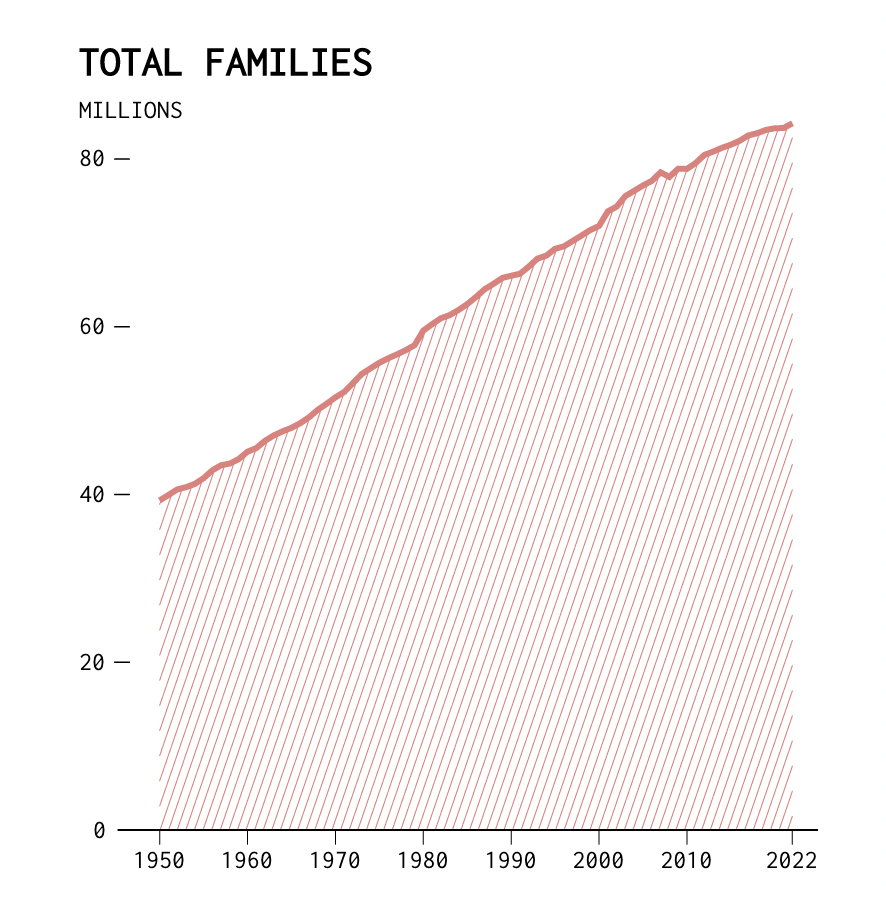
In the 1950s, less than 10% of families with children were single-parent. In 2022, among families with children, 31% were single-parent — more than three times as common.

The total number of families went up. There were 84.2 million of them in 2022.

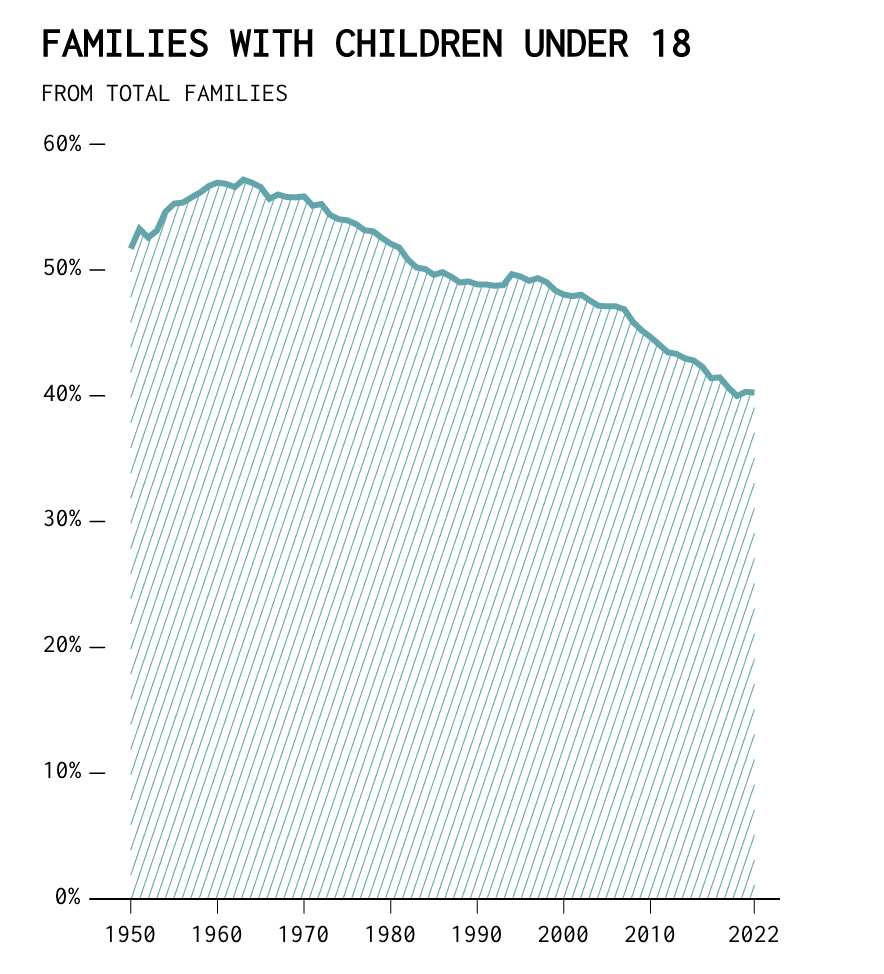
There was also a growing number of families with children (under 18, living with a parent), but that changed around the time of the Great Recession between 2007 and 2008.

After the baby boom through the early 1960s, families had fewer children overall. This is more obvious as a percentage of total families.

Divorce is more common, so single-parent families are more common. It looked like it was on the way down starting in 2013, but there was an uptick in 2021. The rate stayed the same in 2022 at 31%.

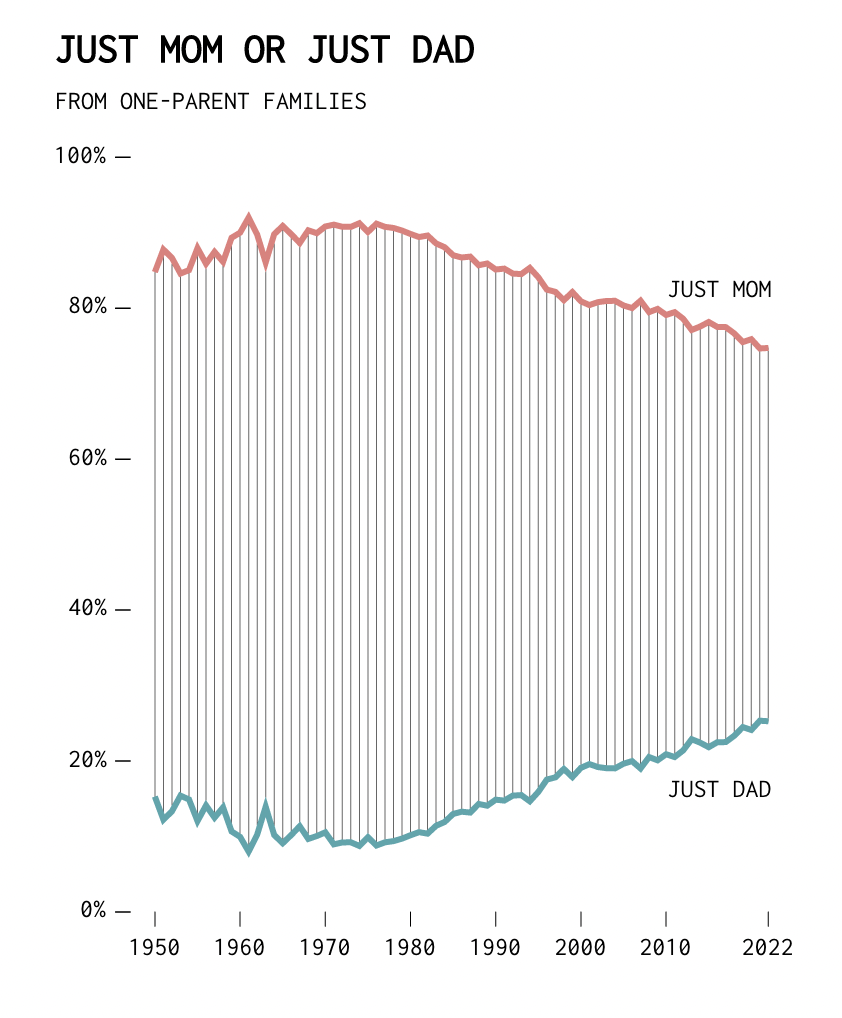
Single-parent families usually meant children lived with their mothers, and it still does, but that seems to be changing. It was 66% more likely for children to live with their father in 2022 than in 1950.

My son was a Columbine shooter. This is my story.

Not sure how I came across this but it was extremely powerful to watch. I can’t imagine being the mom of a child who was responsible for a mass shooting at a school. It takes a lot of guts to confront people and tell this story and Sue Klebold spent a long time doing just that. She has become an activist to advance mental health awareness and suicide prevention. I wanted to share.

My sons oppositional defiant disorder is relentless, but I won’t give up on him.

By Colleen Dilthey Thomas

My impressions of what motherhood was about before I had children are quite different than what it is really like. I wasn’t so naive that I thought I’d have children who never misbehaved and were the consummate obedient Stepfords, but I certainly never expected a child with a behavioral disorder either. When my son was around 7 years old, we realized that he was different. There was anger and defiance that I recognized were not typical of a boy his age, and were also uncharacteristic of his normally cheerful and sweet demeanor.

There were outbursts and arguments that became too much for me to handle on my own. I knew that this was far beyond my pay grade and that I needed to seek professional help. My son was already being treated for ADHD, and when I brought my concerns to his doctor, she explained that he was exhibiting behaviors of Oppositional Defiant Disorder. I had never heard of this before, but I was instantly concerned. What challenges were ahead for my son and the rest of our family? How would we work through this? What were the long-term effects? Was it Terminal? No. Life altering? Absolutely.

The world of ODD is complicated. There are plenty of people who don’t believe that it is a real diagnosis; they think that the child is simply not being raised right. There isn’t enough discipline. The parent isn’t insisting on enough respect. The child is in charge. Ask any mom of an ODD kid and they’ll fight you all day that not only is it a real diagnosis, they’re likely drowning in it. Every day their wherewithal is being tested and they probably feel like a failure. You see, they remember that sweet baby who they nursed and cared for. There were days of sweet giggles and kisses. That child was not always battling them. But then, in a blink, everything changed.When a child has ODD, they will often target their behaviors toward one person. Lucky for me, I am the one he wants to battle. He always wants the last word. I know I should walk away, but I’ll be darned if I am going to let a kid win. He has to learn respect somehow, right? But when I argue, he is winning. He’s getting a rise out of me, just as he intends to.That’s probably the most difficult part. He wants to fight me, his mom. Shouldn’t I be the one who he comes to when he is facing troubles? I always thought that I would be the problem solver, not the one who he hates. Hate is probably a strong word, but I am definitely his biggest frenemy right now. I just want him to be happy.

It sounds so simple, but isn’t that every mother’s wish? No one wants to see their child hurting. His pain is being expressed in argument and anger. My heart is broken for my baby boy.I know that I am not alone in this fight. There are so many kids with ODD who are challenging their mothers every day. Those moms love those children. But they are frustrated, and they are sad, and they are broken. They wonder each day why this is happening to their families. And yeah, they look at other families with envy from time to time. You know what? That’s OK. This doesn’t have to be a life sentence. There is hope for change.

There is one absolute truth in this whole thing, and that is that I am a good mom. I do all of the things that a mom is supposed to do for her children. They are nurtured and cared for and loved. My God, they are so very loved. No, my other children aren’t bogged down with the same problems, but I don’t love them more because of that.

Truth be told, I probably love my son the hardest. I do it because I want him to love me back. Sure, he loves me, but I sometimes wonder if he likes me as much as he dislikes me right now. Does he remember his life before he was so angry? Are there flashbacks of happy times that didn’t include daily arguments? Surely there are. And there are bright days ahead. I know that. But I have to put in the time and the patience with him to ensure that those days come.

ODD won’t rule my life — or his. It will cause challenges and heartache from time to time, but I am not going to let it change the way that I feel about my son. I will not give it the power to make my love for him wane. Instead, I am going to work the plan and give him what he needs: discipline and understanding, but most of all, love. He needs to feel like he is seen for the good and not just the bad.

I sometimes think that I am a better mom because of ODD. It has challenged me to be the best I can, every single day. I am guided by an inner strength which I didn’t really know existed. If you are struggling with ODD, you are not alone. There are other moms that are struggling just like you. Don’t forget, you are a great mom and your child loves you. Take a deep breath and walk away. It sometimes feels like there are no winners with ODD, but sustaining your love and patience for your child makes you the ultimate victor.

CORONAVIRUS IS HERE TO STAY BUT . . .

Q&A with spiritual leader Alessandra Bogner (Read on to find out)

Corona! Corona! Corona!

What else can anyone say that hasn’t already been said.  It’s changed all of our lives, gave us new perspectives, raised lots of questions about healthcare, safety, government, school protocol and vaccines.  And hopefully made us appreciate life and kindness a little more.

We will all be reading about Covid 19 and the 2020 year in history, but I didn’t want to write an article about how challenging the year was, we all got that.  Parents became teachers (and therapists and nurses and much more), many lost their jobs, people moved to other place, and most importantly, many lost loved ones.

I wanted to write something that focuses on the positive.  We all know that out of many disasters, enlightenment comes, a new way of doing things, a new way of learning.  Yes, parents became teachers, but we learned to appreciate them a lot more and spent precious time with our kids.  Yes, many people lost their jobs, but lots of people also re-invented themselves and found new and better ways of earning a living.  And while many people lost loved ones, extraordinary acts of kindness were displayed because whether you lost someone or not, we all understood and grieved together. 

I was reading something that my good friend Ali Bogner wrote about the “new normal”.  We’ve heard this term before but what does it really mean?  She wrote, “The Universe is showing us that going back to “normal” was not the point of this pandemic. That so-called “normal” we are wishing for is actually what got us into this situation, so we need to evolve and expand beyond what we were”.

I consider Ali a spiritual leader, she’s always bringing enlightenment to people.  She is the author of “Lightworkers of Florence” on her Facebook Page, which talks about so many self-awareness topics.  I am happy she agreed to participate in my blog. 

Q:  What do you think is the single most important thing we have learned from this pandemic?

A: I think that the most important thing we learned is how connected we all are. Humanity is at the beginning of understanding our oneness. The universal laws of cause and effect are becoming more obvious in the sense that we are realizing how the actions of each of us has a consequence on the whole. This was a global event unlike any other we’ve experienced in history. We are not able to physically be with each other and yet, globally, we all felt each other.

Some people would argue that the events of the pandemic brought out so much ugly and divided many people, but I ask you to look deeper. Those are just growing pains in the evolution of sensing each other. Sure, there were heated arguments about masks/no masks, lockdown/no lockdown and our old wounds of racism and intolerance popped up everywhere, but this time, it was a global conversation. As an example, the George Floyd incident sparked rage all over the world.  Florence is an amazing place, but not really known for its involvement on American racism, but it was felt here like it was our own. 

I believe that the important things in life are the invisible – that which we cannot perceive with our five senses. Things like love, respect, joy, grace, compassion – and these things have become more important to us. The veil is slowly being lifted and we are starting to see things in more of a collective way.

Q: When we talk about the “new normal” what do you think that means and how do we prepare for it?

A: Nothing irks me more than someone saying, “I can’t wait until we get back to ‘normal.’” Really? Do you want to go back to what got us into this mess? What the new normal will be is a hard question to answer since we are in the midst of collectively manifesting this right now. And that’s how we should look at it – WE are manifesting something new.

The Universe does not make mistakes; we were given this pandemic as a great re-set to observe what works and what doesn’t and we will be the co-creators of a new world. The world is going to re-start and we have this amazing opportunity to make it more humane, more balanced…but first, we have to be uncomfortable where we are and that’s part of the new normal.

So many people have these nagging feelings of uncertainty and fatigue trying to figure out where they see themselves in the future. This is good! We are entering unknown territory and these feelings of doubt should make us go within a bit more and get in touch with our deeper desires.

Q: Our generation never experienced a Global pandemic before, many older people have a different perspective because they have lived through so many other things like the Holocaust or the Great Depression, what kind of philosophical advice can you offer young people who have lots of anxiety and fear right now?

A: I work with and am very connected to many young people and I would say that the number one thing they all have in common is anxiety. It doesn’t matter how good/bad the family is, the socio-economic or ethnic background – these kids are anxious and that anxiety manifests itself in so many ways like depression, eating disorders, cutting, OCD, violence, substance abuse and a plethora of other things. I believe that our kids are being born into a world with an inner knowing that things need to change and they will be the ones to facilitate that change.

If I could somehow inject our youth with something to help them, it would simply be having a strong sense of faith. Faith that their presence right now in the world is incredibly meaningful and that their path, while difficult and unknown, will bring about a great awakening.

If you take a look at all the kids born during the last 25 years, you will notice so many of them have “problems” such as ADHD, being somewhere on the spectrum and a bunch of processing/cognitive/learning “disabilities.” But I feel certain that it’s “US” who have the disabilities in understanding them. They’ve come into this world “different” because they are ready for something we can’t quite comprehend yet.

Q:  Some people believe that the pandemic had to happen for significant change to come, can you elaborate on this? 

A: We have watched the world turn into this great, egoistic monster that finds its importance in material things and the desire to control. We have observed a lack compassion and respect for each other and our planet. In just a few short months of keeping people at home, there has been significant improvement in the environment from the air to our waters. I think this will bring about a change in how we relate to and treat each other and the planet.

Q:  Because my blog is about parenting, what do you think as parents became most valuable lesson during the pandemic?

A: Parents dealt with so much, didn’t they? Throughout the pandemic, I kept saying “Thank God my kid is older!!” But I know that there were so many parents out there struggling on how to navigate being both parents and teachers during this time without losing their shit.

But it brought about an awareness on how each kid learns differently, the scope of education and what our kids need to be able to thrive in this world. I think our current school systems are extremely antiquated and do not serve this new generation. I was amazed at the resilience and growth that happened with the creation of different ways to teach our kids and the respect we now have for our teachers. The lessons are still being realized, but I believe that as parents, the greatest lesson is that we need to view education differently.

In the past, we have seen the most significant changes come about from passionate parents who want something better for their kids. In fact, my son completed his elementary education in the NYC public school system and I watched schools that transformed into evolved learning environments, not only because of teachers and administrators, but from parents getting involved and creating new structures. The old structures and belief systems surrounding education are now being questioned and this is an opportunity to bring about an evolution in education.

I would like to add that whether you are a parent or not, we collectively need to be there for all our kids. The lockdowns/isolation have affected our kids in ways we cannot imagine. This is not only a problem for the parents and professionals, but for our global village. How are you extending kindness and compassion to every child you meet?

Q: On the one hand, this pandemic seems like a great equalizer, on the other hand it seems like a lot of disparity came up, people who didn’t have resources mostly low-income folks and minorities hurt more, how do you think the “new normal” will change this?

A: I absolutely see this disparity, but again, I think that we have taken the first step toward something different as we sense our connection to each other more and more. I think that people are starting to realize what is really important and it has little to do with owning things. Ultimately, the cure for all our troubles is to unite. While we are certainly not there yet, I believe we have made it to the first level. Growth is not easy and often painful, which is where we are now.

Q:  Not to get political but it became clear we need great leadership during extremely tough times, what do you expect from our leaders during a time of crisis, whether they are government leaders or spiritual leaders?

A: The thing that struck me the most during the pandemic was the absence of great leadership anywhere. What a huge disappointment!! We questioned the motives of all the leaders, because we felt that their decisions and intentions were not in alignment with a greater good for all. Everything felt slathered with secrecy, self-interest and corruption. Is it any wonder why the world of conspiracy theories took on a life of its own? The flip side of this is the lesson that our children are learning. I have a great amount of faith that the kids today will one day become great leaders.

Q:  What acts of kindness did you see that really struck you during the pandemic?

A: I am pleased to say that I witnessed so many! My two favorites are:

People checking in on the elderly to see if they need anything and daily rituals to bring up people’s spirits – such as the 7pm celebration for essential workers in NY and the “balcony singing” of people in Italy.

Q:  Can you finish this sentence “Corona Virus is probably here to stay but  .   .   . 

A:  It is teaching us what is important and will lead to a great renaissance. Look at the black plague of the 1300’s that killed off more than half the population in many European and Asian cities, yet, it brought about the Renaissance that elevated how the world thought.

Instagram – lightworkers_of_florence

@lightworkersofflorence

When Your Child Needs Early Intervention

(Q&A with ABA Therapist Rosalind Greenberg below)

At 17 months, my son started showing signs of unsettling behavior. The tantrums were long and exhaustive, he started biting and scratching and he was extremely hyperactive. I didn’t think much of any of this as I knew the “terrible twos” were approaching, he wasn’t able to communicate abundantly yet, and I guess I just thought my son just had it a little worse than other toddlers.

Avoid-behavior-challenges-lead-photo-426x213

The Daycare where Luke attended at the time suggested getting him evaluated and reluctantly, I agreed as I was tired of hearing how disruptive he had become. I had been challenged myself with Luke at home but also rationalized that kids are always worse with their parents than outside the home.

Luke was evaluated at around 21 months and cognitively there were no issues. The OT therapist (Occupational Therapy) also told me there were no major issues, but he would recommend some OT just to keep him grounded and focused, great, it can only help I thought. He didn’t qualify for speech because I was told his receptive language was developing at the standard rate even though his expressive language skills were a bit lacking, okay I could live with that. Then came the eye-opener, the behavioral evaluation.

Like most toddlers, Luke had good and bad days. On the day of his behavioral evaluation, he had a complete meltdown, throwing things, crying, not listening, not making eye-contact, very little communication, so when I finally spoke to this evaluator, she told me there could be signs of Luke being on the Autism Spectrum. As any parent, I was in complete denial and quite angry and upset over this news.

bigstock-Child-with-angry-expression-12160457-optimised-300x208

Based on his behavioral evaluation, Luke was granted ABA services (applied behavioral analysis) and we came to find later that fortunately, Luke was not on the Autism Spectrum. While that was a huge relief to me, it also made me worry about what was really going on with him.

Luke is now three years old and there still isn’t a clear diagnosis of what’s going on with him, but we all agree it’s something, perhaps ADHD although it’s difficult to diagnose ADHD at such a young age.

At age three, the Department of Education gets involved, and they bring in their own standardized test measurements. They almost didn’t grant him services as he did fairly well on his evaluations this time around, the DOE has to find a big area of deficit or weakness to provide services and if that isn’t strong, they give it to other kids who may be more in need. All the help he had gotten in the previous 10 months had no doubt helped. Luke received a lot of one-on-one attention so when he would have a melt-down, he had someone there to re-direct him, calm him down and it was working.

After much pleading and cajoling at the meeting to see if Luke would get continued services, the DOE granted Luke an IEP (individualized education plan) but with minimal behavioral assistance. He received continued OT but this time Speech was added as we started to realize, his communication was a big source of his frustration. I was concerned about the reduced hours, he went from 20 hours of behavioral therapy a week to only 10 now, and my fears proved true, the reduced hours were hindering Luke and he was starting to regress and act out again.

I’ve been working with the DOE to figure out the best solution for him and it’s been challenging and emotional.  I think as a parent, you just want your child to be well-adjusted, learn and be an overall good kid. Of course, all kids have behavioral issues, they are just little humans full of energy and impulsivity. They don’t understand the rules of society or classrooms or standards that we sometimes place on them. I will continue to do whatever it takes to help my son as that’s what parents do, but there are many lessons to be learned, even as I move forward to figuring out what the problem is and getting him the right help.

images-1

Here some of what I have learned 1) put aside your preconceived ideas about special education and get your child help, however and whatever that may be 2) any help is better than no help and will only be beneficial 3) Talk to as many people as possible, parent, teachers, psychologists, etc. 4) get yourself some help as you will surely need it whether that’s talking to a therapist, or medication or an extra set of hands so you have some relief, trust me on this one.

For more lessons, I spoke with Rosalind Greenberg (Licensed Master Social Worker that specializes in ABA therapy and Luke’s best buddy) for professional advice:

Q. What are the biggest misperceptions about Early Childhood Intervention?
The biggest misconception is that if a child is receiving early intervention services it will negatively impact his future educational choices and how others will look at him.
Q. How do you know if your child needs special services such as OT or Speech or ABA?  What are the signs?
The first sign is when a child has a difficult time communicating. It can start as early as 12-months. The child is not babbling or not saying “mama” “dada”. The need for OT usually revolves around play and feeding. Is the child having difficulty holding toys, picking up finger foods. Is he holding a cup/bottle/spoon with all fingers. Is the child able to tolerate all textures of foods in terms of sensory. ABA is discussed and needed when the child has poor eye contact, not responding to his name, showing behaviors that are impacting his development. ABA while used primarily for children with Autism, is also provided for children who need help in terms of behavior and following routines and structure.
Q. In your experience, how has early childhood intervention been beneficial?  Was there ever a case that it didn’t work or help?
Early intervention is beneficial because it gives the children and their caregivers the tools, structure and routines that the child needs to develop. Not every child will be able to speak, but every child will be able to communicate. Therapy is only a short time in a child’s day and life, the activities that the caregivers need to follow when the child is not receiving therapy is crucial. It’s about consistently working in helping a child as a team. Early Intervention always helps but not always as much as a family wants. Its gives tools, activities, exercises that has to be consistently done. It may be able to get rid of certain issues, but it does not “cure” diagnoses.
Q. With Luke it was tricky because his behavior was never extensively bad but he clearly needed help, how are the standard evaluations/tests helpful or not helpful in this case.  In other words, are the tests and evaluations enough to see what’s really going on?  What other measures are there?
Evaluations are important because it highlights where the delay is, i.e cognitive, speech, or adaptive related to activities of daily living. Most important is the observation and the interview the parents gave with the evaluator.
Q. It seems like kids today are more scrutinized and under a microscope than ever before, do you agree and if so, how do you take that into account when observing a child? 
The education system has different expectations of a child than even 10-years ago. A child is expected to be in an educational environment by the age of 3, be aware of his environment, follow a classroom routine and sit for a period of time. Yes, when observing a child, this is taken into account.
Q. I’ve gotten the sense that there’s added pressure on kids today in school to be obedient, smart and cooperative kids, which doesn’t leave much room for them to play and just be kids.  How important is free play for a child and at what age should they really be attentive and studious children?
Free play and physical activity is crucial for children of all ages. Obviously, the older a child gets, there is more school work, but there always needs to be a balance. By the age of 6 child needs to be able to sit behind a desk, but again needs time to play ball, jump rope etc. Going to the park, movement classes are just as crucial as learning the alphabet and addition and subtraction.
Q. Any other advice for parents that are perhaps dealing with a child that needs special attention?
To get your child services as early as possible. When in doubt, have the child evaluated. The earlier the better. Be involved with your child’s services, so you can follow the structure on your own.
images-2